

You Can Add a Lock. You Can't Add a Foundation.
Why privacy has to be poured with the concrete, not bolted on afterward.

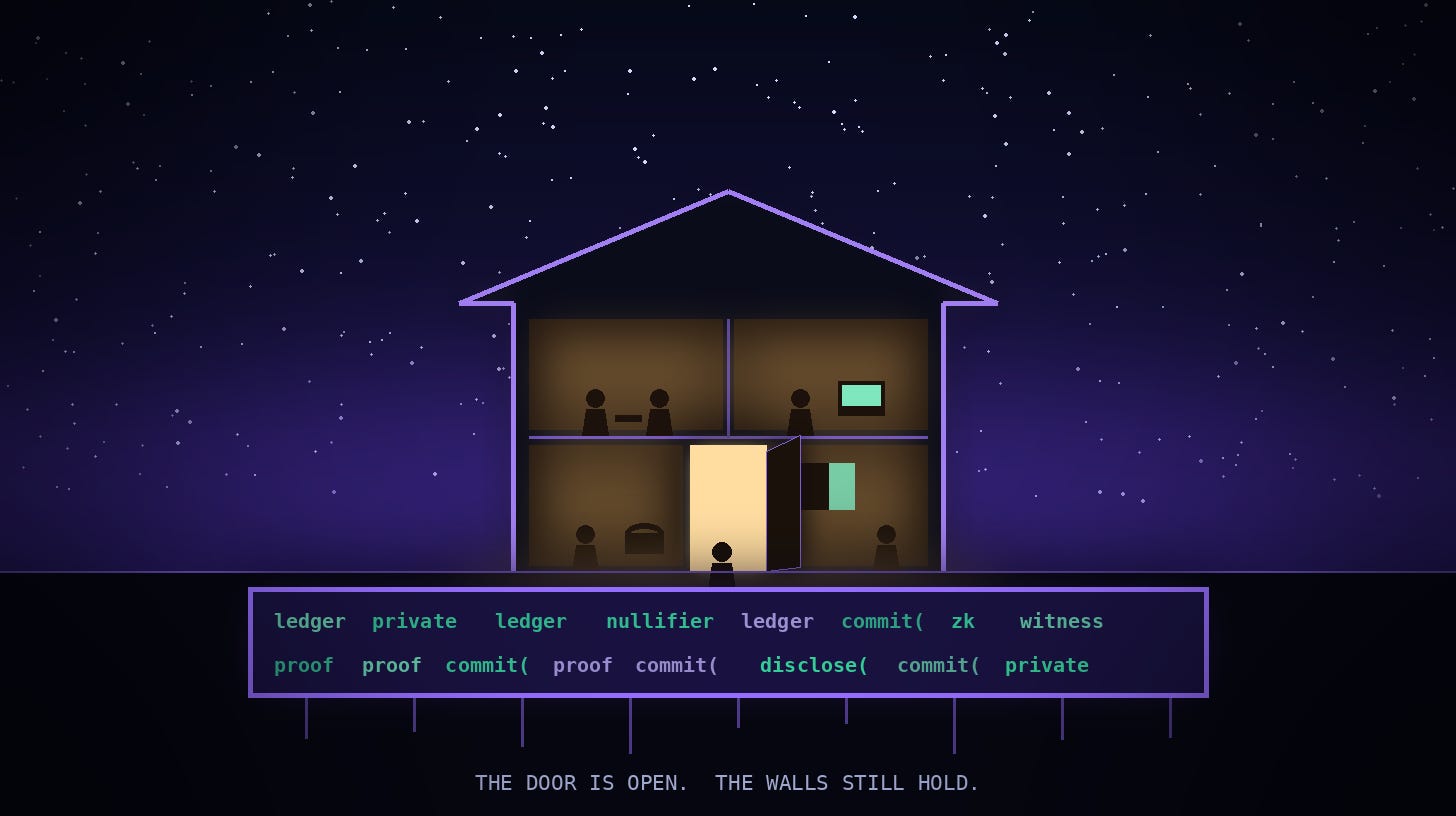
You can add a lock to a house. You can add cameras, bars on the windows, a safe in the closet. What you cannot add is a foundation. That gets poured once, before anything else exists, and every wall you ever build sits on top of whatever decision you made that day.
Software is the same. Some things are features you bolt on later. Some things are foundations, and if you skip them at the start you spend the rest of the project working around the gap.
Privacy is a foundation.
What the earlier chains were actually built for
It’s worth being fair here, because the first generation of blockchains solved a genuinely hard problem and solved it well.
The problem was this: how do total strangers agree on what happened, with no bank, no government, no referee in the middle? The answer they landed on was radical. Make everything public. If every transaction is visible to everyone forever, nobody has to trust anybody. You can just check.
That was the breakthrough. It worked. It still works.
But look closely at the shape of that answer. Verification was achieved by means of visibility. The two got welded together. Proving something was true required showing everyone the underlying data.
Nobody in that room was being careless about privacy. Privacy simply wasn’t the problem they were solving.
Why you can’t just add it later
Here’s where the foundation metaphor stops being a metaphor.
If your system’s core assumption is that everything is visible, then every layer built on top inherits that assumption. The wallets assume it. The explorers assume it. The tooling, the standards, the applications, all of it was designed in a world where the data is public.
So when you try to add privacy afterward, you aren’t adding a feature. You’re contradicting the foundation. And you end up with the patterns we all recognize: a private thing bolted to the side of a public thing. An optional mode most people don’t turn on. A mixer. A separate chain. A layer that works if you use it exactly right and quietly leaks if you don’t.
None of that is stupid. Some of it is very clever engineering. But it’s all renovation work, and renovation is always harder than building it right the first time.
The tell is that privacy becomes something you have to do. A step you remember. An option you select. And anything that depends on a person remembering to do the right thing eventually fails, because people are busy and defaults win.
What built-in actually looks like
Midnight starts from a different assumption, and you can see it in the architecture rather than the marketing.
There isn’t one shared public state that everyone reads. There are two. A public state, for the things that genuinely need to be verified on chain. And a private state that stays with the user and never gets exposed.
That sounds like a small design choice. It isn’t. It means the sensitive data was never on the chain to begin with. You’re not hiding it. It was never there.
Verification still happens, through zero knowledge proofs. You prove the thing is true without handing over what makes it true. Prove you have enough funds without showing your balance. Prove you’re eligible without showing who you are.
The word for this is selective disclosure, and the important part is the direction it runs.
Privacy is the default. Revealing something is the deliberate act.
That’s the inverse of how the rest of the internet works, where collection is the default and privacy is a setting you go hunting for in a menu.
The part that convinced me
I’ll be honest, I didn’t find this convincing when I read it in a whitepaper. I found it convincing when the compiler yelled at me.
Writing a contract in Compact, Midnight’s smart contract language, I tried to move some private data into a place where it would end up visible on chain. Nothing dramatic. The kind of thing you’d write without a second thought on a transparent chain, because on a transparent chain there is no second thought to have.
It refused to compile.
Not a warning. Not a linter suggestion I could ignore on a deadline. The language would not let me do it until I explicitly declared, in the code, that I was choosing to disclose that value.
That’s what a foundation feels like from the inside. It isn’t a promise in the documentation. It’s a wall you walk into. The system is built so that leaking data is something you have to go out of your way to do, rather than something that happens because you were moving fast on a Tuesday.
Same story with the fees, which is the part almost nobody thinks about. On a transparent chain, even if the contents of your transaction were somehow private, the fee you paid is public, the token is public, the balance it came from is public. You hid the letter and left your fingerprints on the envelope. Midnight uses a separate, shielded resource for fees precisely so that paying for privacy doesn’t cost you your privacy.
That’s not a feature anyone would add later. Nobody retrofits their entire fee model. That’s a decision made at the foundation.
What I’m not saying
I’m not saying the older chains got it wrong. They answered the question they were asked, and the answer was good enough to create an entire industry. Everything since, including Midnight, is standing on that work.
I’m also not saying privacy by design makes anything perfect. Foundations don’t build the house. Plenty can still go wrong upstairs. Bad code is bad code on any chain.
What I am saying is narrower and, I think, harder to argue with. Some properties can be added later and some cannot. Privacy is in the second group. If it wasn’t in the plan before the first block, you will spend forever approximating it.
Why it matters now
For years this was an academic argument, because the only people on chain were people who didn’t mind being watched.
That’s changing. The moment real businesses and real institutions show up, the question stops being philosophical. No company runs on a system where competitors can see their customers in real time. No hospital puts patient records somewhere permanently public. No regulator accepts trust us, and no user should have to.
Those aren’t privacy nice to haves. They’re the entry requirements. And a system that treats them as foundational is playing a different game than one treating them as a roadmap item.
You can add a lock to a house.
You cannot add a foundation. That part had to be right on day one.