

Why Businesses Can’t Use Most Blockchains (Yet)
Why transparency, privacy, and trust don’t fit together the way most blockchains assume

There’s a persistent idea in crypto that business adoption is inevitable, as if companies are simply waiting for the technology to mature before moving everything on-chain.
That story sounds reasonable, but it misses something more important. For many businesses, the problem isn’t timing or awareness. It’s that most blockchains, as they exist today, don’t fit how businesses actually operate.
The Transparency Trade-Off
Public blockchains are built around a clear principle: everything should be verifiable. The simplest way to achieve that is to make information visible, so anyone can independently confirm what has happened.
This design works remarkably well in open systems where participants do not know or trust each other. It removes the need for intermediaries and replaces them with shared rules.
However, that same transparency becomes difficult to work with in a business environment, where visibility is not always an advantage.
What “Going On-Chain” Really Exposes
When business activity moves onto a public blockchain, the exposure goes beyond individual transactions. Over time, patterns begin to emerge, and those patterns can be surprisingly revealing.
A determined observer can often piece together:
how value moves between entities
when payments are made and how frequently
which participants interact with each other
how activity changes over time
None of this requires access to private databases. It comes from observing what is already public and connecting the dots.
For a business, that can amount to a slow leak of strategic information.
Why That Matters More Than It Seems
Companies depend on controlling certain types of information, not because they are hiding wrongdoing, but because that information has competitive value. Pricing strategies, supplier relationships, and customer behavior all shape how a business competes.
If those signals become visible, even indirectly, competitors gain insight without having to invest in research or analysis. Over time, that erodes any advantage the business has built.
This is why full transparency, while appealing in theory, often becomes a liability in practice.
It’s Not Just a Competitive Issue
There are also regulatory and customer considerations that make full transparency difficult to adopt. Businesses operate under different legal frameworks depending on jurisdiction, and many of those frameworks impose strict rules on how data can be handled and shared.
At the same time, customers rarely expect their activity to be observable, even in an abstracted form. The idea that their interactions could be analysed through public data can create discomfort, regardless of whether identities are directly attached.
Taken together, these factors mean that transparency is not just a design choice. In many cases, it becomes a constraint.
Why Private Blockchains Don’t Fully Solve It
Private or permissioned systems attempt to address this by limiting who can access the network and what they can see. This makes them more suitable for controlled environments, where participants are known and governance is clearly defined.
They can provide privacy and predictability, which are both valuable in a business context. However, this comes at the cost of reintroducing trust.
Once participation is restricted, someone has to manage access and enforce rules. The system becomes dependent on its operators, which reduces the neutrality that makes public blockchains distinctive in the first place.
At that point, the line between a blockchain and a traditional shared database starts to blur.
The Underlying Mismatch
The deeper issue is that most blockchains were not designed with business requirements in mind. They were built to solve the problem of coordinating trust in open, adversarial environments.
That goal naturally led to an emphasis on transparency, because visibility made verification straightforward.
Businesses, on the other hand, need a more nuanced balance. They require systems that can be verified without exposing sensitive information, and they often need to share data selectively depending on context.
When those needs meet fully transparent systems, friction is inevitable.
What Needs to Change
For blockchains to become genuinely useful in business settings, the model has to evolve beyond this all-or-nothing approach.
In practical terms, that means enabling a few capabilities at once:
transactions and rules must still be verifiable
sensitive data must remain confidential
information must be shareable on a selective basis
systems must align with regulatory requirements
Most existing designs force trade-offs between these. That is the barrier businesses are responding to.
A Shift in Direction
Some newer approaches are beginning to separate what needs to be public from what should remain private, rather than treating all data as something that belongs on-chain.
In these models, sensitive information can remain with the user or organisation, while the network only sees proof that certain conditions have been met. This allows verification to take place without full visibility into the underlying data.
The concept is simple, even if the implementation is complex. You can prove something is true without revealing everything behind it.
Why This Matters
Once that capability exists, the conversation around adoption starts to change. It is no longer about asking businesses to accept uncomfortable trade-offs. Instead, it becomes possible to design systems that align more closely with how they already operate.
Transparency and confidentiality no longer have to cancel each other out. They can be applied where each one makes sense.
That is the point where blockchains begin to move from experimental tools into something more broadly usable.
Final Thought
Businesses are not ignoring blockchains because they are slow or resistant to change. They are responding to real constraints that current designs have not fully addressed.
Public systems expose more than most businesses can accept, while private systems rely on levels of trust that reduce their appeal.
Bridging that gap is not a small improvement. It is the step that determines whether blockchains remain a niche technology or become part of everyday infrastructure.
What Changes This
If the issue is structural, then the solution has to be structural too.
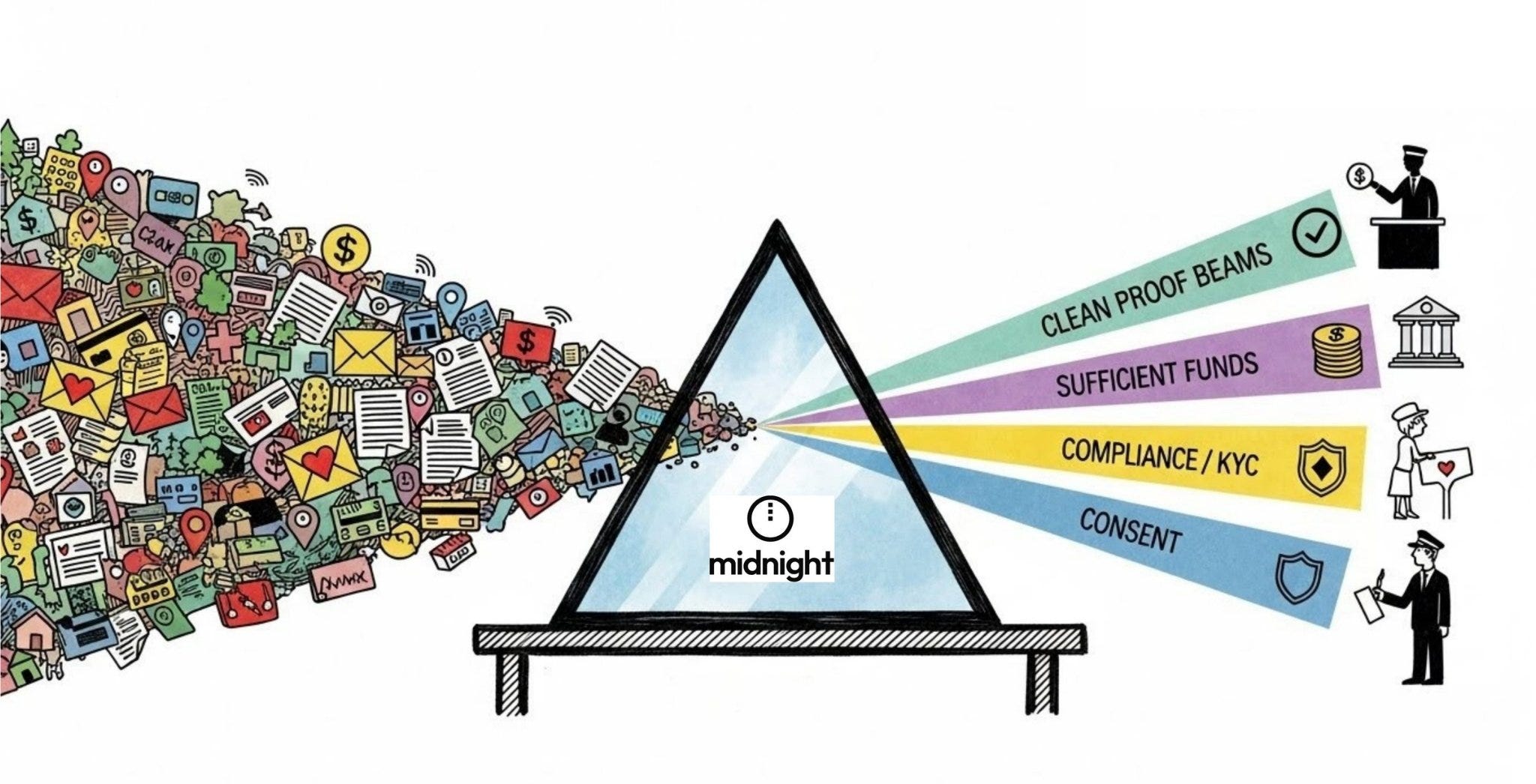
Projects like Midnight are starting to rethink how blockchains handle data altogether. Instead of treating everything as something that must live on-chain, they separate what needs to be verified from what needs to remain private.
In practice, that means two things can exist at the same time. There is a public layer where the network can confirm that rules have been followed, and a private layer where sensitive data never leaves the user.
The interesting part is how those two layers connect.
Rather than exposing information, these systems rely on cryptographic proofs to show that something is true without revealing the underlying data. A transaction can be validated, or a rule enforced, without making the details visible to everyone.
This approach also changes how compliance works. Instead of exposing everything by default, information can be disclosed only when required, and only to the parties that need to see it.
Even some of the more subtle issues, like patterns of activity and metadata leakage, start to look different under this model, because not every interaction leaves a fully traceable trail.
From a developer perspective, the goal is also shifting. Instead of requiring deep expertise in cryptography, newer tools aim to make these systems easier to build on, so privacy doesn’t come at the cost of accessibility.
None of this is fully solved yet, but the direction is clear.
The next generation of blockchains won’t be defined by how transparent they are, but by how well they balance verification with control.