

The 3 Layers of Privacy: What Midnight Unlocks
Why privacy isn’t about secrecy, but about control, context, and proof


Most people think privacy is a simple switch. Something is either public or private, visible or hidden, shared or locked away.
That framing feels intuitive, but it breaks down quickly once you look at how information actually behaves in the real world. Privacy isn’t a single decision. It operates in layers, and each layer reveals something different.
Understanding those layers changes how you think about blockchains entirely.
The First Layer: What You Choose to Show
The most obvious layer of privacy is the one we interact with directly. It’s the information you intentionally make visible, whether that’s a transaction, an identity, or a piece of data.
Most public blockchains operate almost entirely at this level. Information is exposed so that it can be verified, and verification is what gives the system its credibility. Private systems attempt to solve this by hiding that information instead, restricting access to a known set of participants.
Both approaches make sense in isolation, but they simplify privacy into an all-or-nothing decision. Either everything is visible, or nothing is. In practice, that’s rarely how things work.
The Second Layer: What Can Be Inferred
Even when explicit data is hidden, information doesn’t simply disappear. It leaves traces in the form of patterns, and those patterns can be just as revealing as the data itself.
Over time, it becomes possible to observe how activity flows through a system. You can see when interactions occur, how frequently they happen, and how different participants are connected. Individually, these signals may seem insignificant, but together they form a picture that is often surprisingly detailed.
This is why privacy is not just about what you show. It is also about what others can learn without being told directly.
Many systems underestimate this layer. They focus on hiding the obvious details while still allowing behavior to remain visible. In doing so, they protect the surface but leave the structure exposed.
The Third Layer: What Needs to Be Proven
Once you move past visibility and inference, a different question starts to emerge. Instead of asking what should be shown or hidden, you begin to ask what actually needs to be proven.
In many cases, full transparency is unnecessary. A system does not need to know every detail to confirm that something is valid. It only needs to know that certain conditions have been met.
A transaction can be verified without revealing the exact balance behind it. A user can demonstrate eligibility without exposing their identity. A set of rules can be enforced without showing every input that led to the outcome.
This layer separates verification from exposure, and that separation is where things start to change.
Where Most Systems Stop
Public blockchains tend to prioritize visibility because it makes verification straightforward. Private systems focus on restricting access, which protects some information but does not fully address what can be inferred over time.
Very few systems are designed around the idea that proof itself can exist independently of both visibility and inference. As a result, they solve parts of the problem without addressing it as a whole.
What Midnight Unlocks
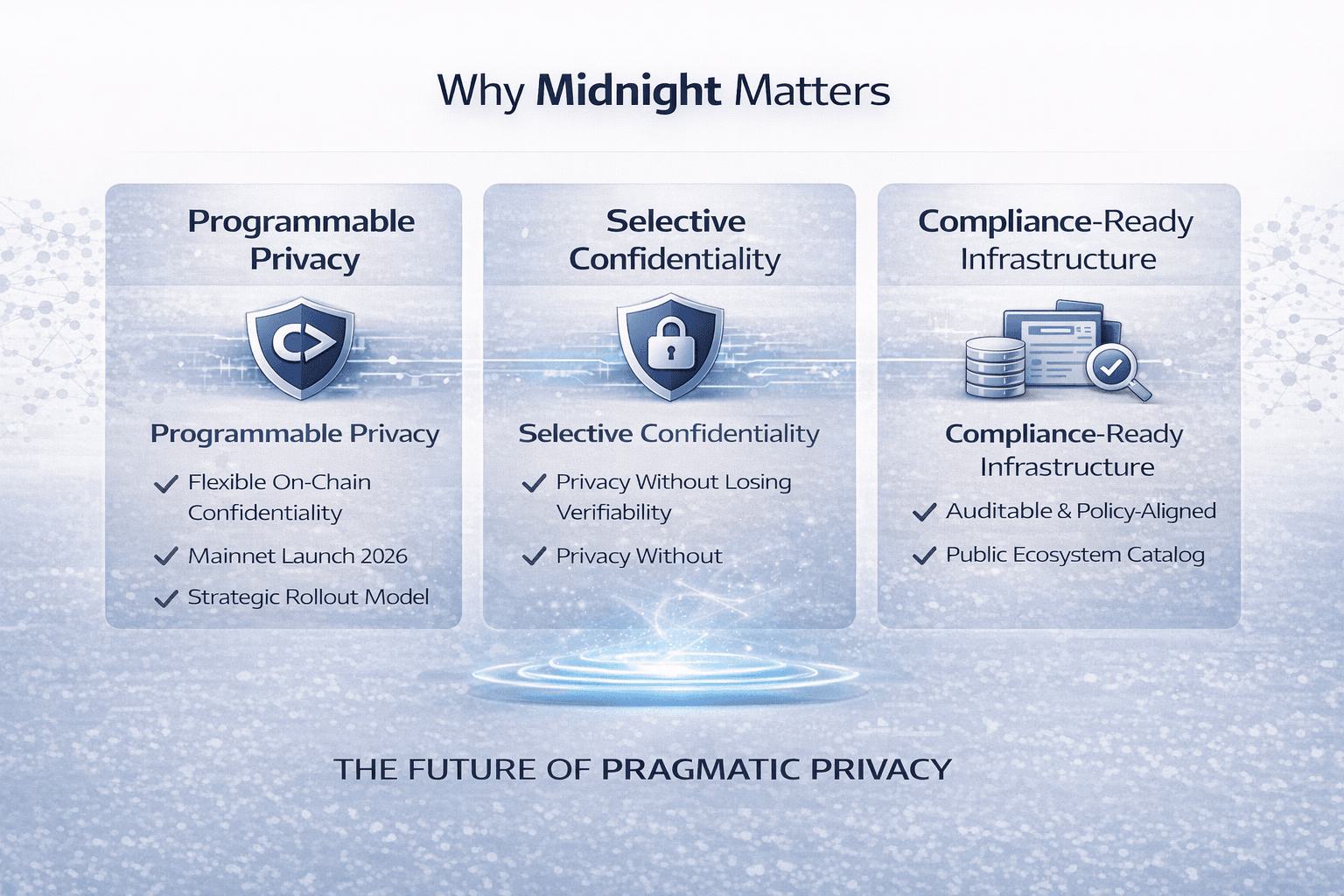
Midnight approaches privacy differently by treating these layers as distinct rather than collapsing them into a single choice. Privacy is the default, not an optional add-on. Information is only revealed when there is a clear reason to reveal it.
Under the hood, this works by separating public state from private state. The network only needs to see what must be verified, while sensitive information remains with the user. Instead of submitting raw data, users submit cryptographic proof that the required conditions have been met.
That may sound technical, but the idea is simple: you can prove something is true without exposing the information that makes it true. This approach also reduces the kind of pattern leakage that often occurs in more transparent systems, since not every interaction leaves behind a fully traceable footprint.
Why This Changes the Conversation
Once you see privacy as layered, the debate around public versus private blockchains starts to feel incomplete.
It is no longer about choosing one side or the other. It becomes about understanding which layer you are operating in, and whether the system you are using gives you control over it.
This is a much closer reflection of how information works outside of blockchains, where visibility, inference, and proof are constantly interacting but rarely identical.
A Different Way to Picture It
It can help to think of most systems as containers.
Some are made of glass, where everything inside is visible at all times. Others are sealed shut, where nothing can be seen from the outside. Both are simple, but neither is particularly flexible.
A more useful model is one where the contents can be verified without being exposed, where you can confirm what matters without opening the container fully. That is the direction these newer designs are moving toward.
Final Thought
Privacy is often treated as a feature that can be added or removed, but in reality it is part of the structure of a system. When that structure only accounts for visibility, it leaves gaps. When it only accounts for restriction, it introduces new limitations.
Thinking in layers makes those gaps easier to see. It also points toward what needs to change for blockchains to become more widely usable. Privacy is not about hiding everything. It is about revealing only what is necessary.

If this changed how you think about privacy, subscribe for more plain-English breakdowns of Midnight, Cardano, and the future of crypto.