

Public vs Private Blockchains: Why Both Exist
Why the false choice between transparency and privacy is holding blockchain back.

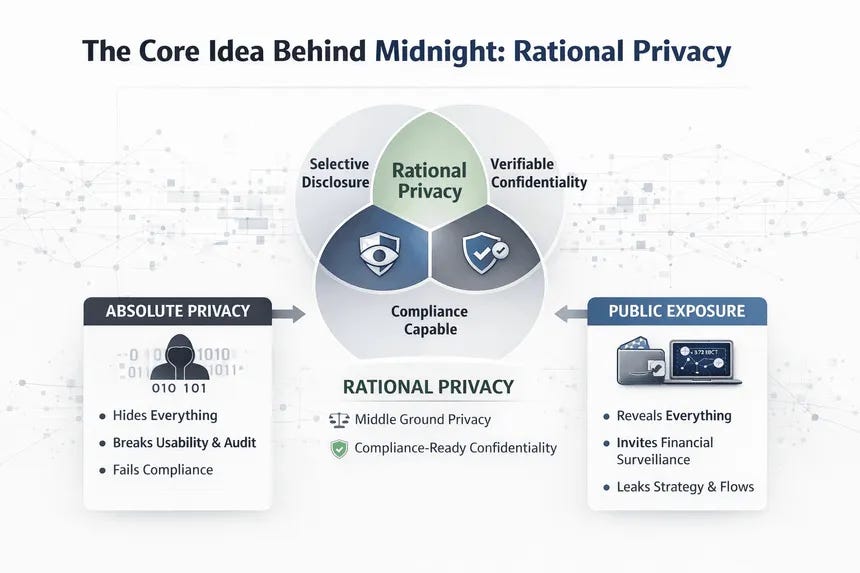
Most debates about blockchains fall into a familiar trap. People frame it as a clean split between public and private systems, as if one will eventually win and make the other obsolete.
That sounds neat, but it doesn’t reflect how the real world works.
Both models exist because they solve different problems, and more importantly, because each one fails in places where the other succeeds.
The Core Difference, Without the Noise
At a basic level, the distinction is simple. Public blockchains are open networks that anyone can join and verify, while private systems restrict access to known participants.
That single design choice ripples outward into everything else, shaping how trust, privacy, and control are handled.
Why Public Blockchains Matter
Public blockchains were designed to remove the need for trust between participants. Instead of relying on institutions, users rely on transparent rules enforced by the network itself.
This openness allows anyone to verify transactions, interact freely, and participate without permission. It is what makes systems like Bitcoin resilient and globally accessible.
There is no central authority deciding who gets in or what is allowed. The system simply runs.
Where Public Systems Start to Struggle
That same transparency, however, comes with a cost that becomes obvious outside of simple use cases.
When everything is visible, you are not just exposing transactions. You are exposing patterns over time. Relationships between participants, flows of value, and behavioral signals all become traceable.
For individuals, this can feel intrusive. For businesses, it is often unacceptable.
Operating a company on a fully transparent system would mean revealing sensitive information about revenue, suppliers, and strategy. In most industries, that is not just uncomfortable. It is commercially dangerous.
Why Private Blockchains Exist
Private blockchains emerged as a response to this problem. By restricting access to known participants, they allow organisations to maintain confidentiality while still using blockchain-style infrastructure.
This makes them useful for internal systems, enterprise coordination, and environments where data needs to be tightly controlled.
They offer privacy, clearer governance, and often better performance because participation is limited and predictable.
The Trade-Off They Introduce
The moment you restrict access, you reintroduce a familiar element: trust.
If someone controls who can participate, then someone is also responsible for enforcing the rules. That shifts the system away from neutrality and back toward a more traditional model where authority matters.
At that point, the question becomes harder to ignore. If trust is required anyway, what is the advantage of using a blockchain at all?
Why This Isn’t a Competition
Public and private blockchains are often presented as competing ideas, but they are better understood as responses to opposing constraints.
Public systems prioritize openness and independence from control. Private systems prioritize confidentiality and coordination within defined groups.
Real-world systems rarely operate entirely at one extreme. They require both transparency and discretion, often within the same process.
This is where the tension begins to show.
The Missing Middle
Most blockchain designs force a choice between visibility and privacy. You either expose everything so it can be verified, or you hide everything and rely on trust within a closed system.
In practice, neither option is sufficient on its own.
There are many situations where you need to prove something is true without revealing all the underlying details. A financial institution might need to demonstrate compliance without exposing every transaction. A user might need to prove eligibility without sharing personal data.
These are not edge cases. They are normal requirements.
Where Midnight Changes the Model
Midnight approaches this problem by separating what needs to be public from what should remain private.
Instead of placing all data on-chain, it introduces two parallel states. There is a public layer that handles verification and shared logic, and a private layer where sensitive data remains with the user.
This allows the system to confirm that something is correct without requiring full visibility into the data itself.
Proving Without Revealing
The mechanism that makes this possible is zero-knowledge proofs. While the underlying mathematics is complex, the outcome is straightforward.
You can demonstrate that a statement is true without revealing the information behind it.
A system can verify that an account has sufficient funds without exposing the exact balance. It can confirm that rules have been followed without showing the full set of inputs.
This shifts the role of transparency. Instead of exposing everything by default, it becomes something that can be controlled and applied where needed.
From Privacy vs Transparency to Control
Once you introduce this capability, the conversation changes.
It is no longer about choosing between public and private systems. It becomes about deciding what should be visible, when it should be visible, and who should be able to see it.
Midnight builds this idea directly into its design. Privacy is the starting point, and any disclosure must be made deliberately. That reduces the risk of accidental exposure and gives users and developers more precise control over their data.
Why This Matters
This shift removes one of the biggest barriers to real-world adoption of blockchain technology.
Organisations can operate without exposing sensitive information, while still benefiting from verifiable systems. Individuals can retain control over their data without stepping outside of the network.
It becomes possible to combine transparency, privacy, and compliance, rather than treating them as trade-offs.
A More Useful Mental Model
It helps to stop thinking of public and private blockchains as opposing sides and start thinking of them as endpoints on a spectrum.
Most existing systems sit close to one end or the other. The real world, however, tends to operate somewhere in between, where different levels of visibility are required at different times.
Midnight is designed to function in that middle space, where both verification and confidentiality are necessary.
Final Thought
Public blockchains showed what is possible when trust is removed from the system. Private systems highlighted the importance of control and discretion.
Neither approach is complete on its own.
The next step is not choosing between them, but finding ways to combine their strengths without inheriting their weaknesses.
If you found this useful, share it with someone still stuck in the “public vs private” debate. What’s your take are we finally moving past the false binary, or is the industry still years away?
I’d love to hear your thoughts below.