

Midnight and the New Era of Decentralized Identity Verification
How Zero-Knowledge Proofs Could Replace Data Sharing With Trustless Verification


Hey all,
So I’ve been researching ZK proofs, decentralized identities (DIDs), reading the Midnight whitepapers, and watching a bunch of videos lately.
In this article, I want to dive into decentralized identity. But before we get there, we need to do a little scene setting.
Privacy Is Not Secrecy
Privacy is frequently conflated with secrecy, but the distinction between the two isn’t just semantic. It’s fundamental.
Secrecy is the act of hiding information to evade accountability. It’s the tool of bad actors, used to obscure illicit activities or dodge the law.
Privacy, on the other hand, is the act of protecting information to ensure security and autonomy.
It’s what allows a business to keep trade secrets from competitors. It’s what allows a company to run payroll without exposing every employee’s salary to the entire office.
As discussed in recent Midnight Summit panels, privacy isn’t about hiding. It’s about preserving the informational advantage that drives markets and protecting the dignity of individuals.
Privacy is normal.
We need to stop viewing it as a gateway to nefarious activity and start viewing it as table stakes for any real-world financial system.
Without privacy, institutions cannot participate.
Without privacy, individuals cannot remain safe.
Enter Midnight: The Era of Rational Privacy
This is where Midnight fundamentally shifts the narrative.
Unlike previous privacy-focused projects that aimed for complete obfuscation, Midnight is built around the concept of Rational Privacy, also known as Selective Disclosure.
Midnight is not designed to help people dodge the law.
It’s designed to help people comply with it without sacrificing their data sovereignty.
Today’s blockchain landscape often forces us to choose between two extremes:
Total transparency, where everyone sees everything.
Total anonymity.
Midnight introduces a third option.
Selective disclosure.
Instead of revealing everything, you reveal only what is necessary.
And nowhere is this capability more important than in the realm of decentralized identity.
The Nightclub Example
We’ve all heard the classic decentralized identity analogy.
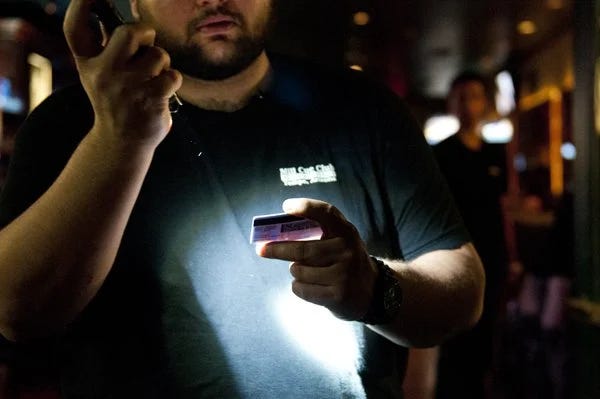
A girl walks up to enter a nightclub.
How It Works Today
The bouncer needs her to prove she’s over 18 (or maybe 21 in your part of the world).
To prove it, she hands over her driver’s licence.
The problem?
She only needed to prove her age.
Instead, she has now shown a complete stranger her full name, address, date of birth, and potentially other personal information.
Some clubs even scan the ID or take a photo to store that information.
How It Could Work Tomorrow
The bouncer still needs proof of age.
This time, she taps her phone, watch, or wristband against the venue’s verification device.
Her wallet contains a decentralized identity credential.
The screen simply displays:
APPROVED
No name.
No address.
No date of birth.
No unnecessary personal information.
The bouncer learns only one thing:
She is eligible to enter.
Pretty cool, right?
But here’s the thing...
That example wasn’t what blew my mind.
Because every time I heard it, I had the same question.
Who issued that credential in the first place?
And couldn’t they be hacked too?
The Verifiable Credential Model
This is where Midnight’s identity model starts getting interesting.
To begin with, Midnight’s identity framework will leverage Hyperledger Identus (formerly Atala Prism), a system that IOG has already invested significant development effort into.
This is known as the Verifiable Credential Model.
How It Works
You go to a trusted issuer.
This could be:
Your bank
A KYC provider
An exchange like Coinbase
A government service
They verify your identity once and issue you a digital credential.
From that point forward, the credential lives in your wallet.
Instead of repeatedly uploading passports, licences, selfies, and personal information to every service you use, you simply present proof that a trusted issuer has already verified you.
The model essentially says:
“I trust Coinbase to verify you, and I trust the credential Coinbase signed.”
That’s already a huge improvement over today’s system.
But Couldn’t They Still Be Hacked?
This was still nagging at me.
After all, Coinbase still has your information.
The answer is yes.
They can still be hacked.
But now there is one trusted verifier rather than hundreds.
Today, every exchange, website, platform, and service asks for your personal information and stores a copy of it.
Every one of those databases becomes a target.
With verifiable credentials, your information only needs to exist with the issuer.
Everyone else receives only the proof.
If those other services get hacked, your personal information isn’t sitting there waiting to be stolen.
Better.
But it gets even better.
The Game Changer: zkTLS
This is where things started getting really interesting.
Perhaps the most revolutionary aspect of this technology is the potential future integration of zkTLS (Zero-Knowledge Transport Layer Security).
zkTLS acts as a bridge between the existing secure web (Web2) and the private blockchain world (Web3).
Today, proving your identity usually means creating yet another account.
You sign up with an identity provider.
You upload documents.
You take selfies.
You create another database full of sensitive information that could potentially be compromised.
zkTLS changes that model entirely.
Instead of creating a new identity profile, you simply leverage the trusted services you already use every day.
Your bank.
Your exchange.
Your government account.
An Australian Example
Most working-age Australians already have verified accounts through myGov, the ATO, or Centrelink.
With zkTLS, you could potentially log into your existing myGov account.
Midnight could then cryptographically verify a specific fact, such as:
“This user is a valid Australian resident.”
Importantly, the blockchain doesn’t need to see your tax records.
It doesn’t need to see your account details.
It doesn’t need your credentials.
It only verifies the fact being proven.
That’s a huge shift.
The model becomes:
“I trust cryptography to verify that you successfully logged into your account, without requiring the issuer to create a new credential or even know who you’ll share the proof with.”
That excited me.
My mind was partially blown.
But I still had one final question.
Who Gives Issuers Authority?
If my bank can issue credentials...
And Coinbase can issue credentials...
Who says they’re allowed to?
Let’s take a step back.
In today’s world, governments effectively have a monopoly on identity.
If I print a passport at home, it’s fake.
If the government prints it, it’s real.
Why?
Because the law grants the government authority.
Simple.
But blockchain turns that model upside down.
The Midnight Trust Model
In the Midnight world, anyone can become an issuer.
I could launch “Degen ID Corporation” tomorrow and start issuing “Verified Billionaire” credentials to everyone.
The blockchain wouldn’t stop me.
It doesn’t care.
So why doesn’t the system break?
Because the verifier acts as the bouncer.
The verifier maintains a trusted list of acceptable issuers.
A nightclub, exchange, or application might establish a rule that says:
“I will accept an Over 18 credential only if it was signed by one of these approved issuers.”
For example:
Government Identity Service
Coinbase Verification
A regulated KYC provider
If someone presents a credential issued by “Degen ID Corporation,” the system simply checks the signature and responds:
Access Denied. Unknown Issuer.
What Actually Blew My Mind
This is the part that really changed how I think about identity.
In the traditional world, authority is granted from the top down.
In the Midnight world, authority is recognised through trust.
The blockchain doesn’t decide who is trustworthy.
The verifier does.
Issuers earn trust through reputation, compliance, audits, reliability, and real-world credibility.
Government agencies become trusted because they follow strict legal frameworks.
Regulated businesses become trusted because they’ve built reputations over time.
Random issuers are ignored because nobody chooses to trust them.
And that’s what finally blew my mind.
In the old world, authority is assigned.
In the Midnight world, authority is recognised.
It’s the inverse of how we’ve traditionally thought about identity.
And because users share proofs instead of personal information, a hacked verifier has very little to steal.
The user becomes safer.
Not because nobody can be hacked.
But because the valuable data isn’t being sprayed across hundreds of databases anymore.
Final Thoughts
There’s a lot more to this topic than I can cover in a single article.
But the deeper I dive into Midnight, the more I realise it isn’t simply building privacy technology.
It’s rethinking how trust works in a digital world.
The goal isn’t secrecy.
The goal is proving what matters while revealing as little as possible.
And if Midnight succeeds, decentralized identity could end up being one of the most impactful use cases in the entire ecosystem.

Dvnc Author and Writer. X Handle: @dvnc_00
 | A guest post by
|